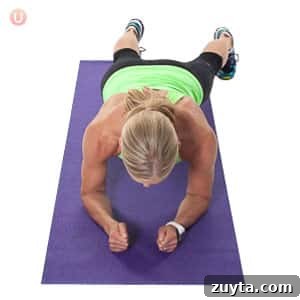
The In In Out Out Plank is a dynamic plank variation that builds core stability while also challenging the shoulders, upper back, and hip muscles. Unlike a static plank, this movement requires controlled motion of the legs while you keep your torso steady, which trains the deep abdominal muscles and improves overall body control.
Stabilization is a foundational but often overlooked part of fitness. Rather than chasing visible muscle definition alone, developing the ability to stabilize your spine and pelvis during movement reduces the risk of injury and makes other exercises more effective. The In In Out Out Plank teaches you to maintain a stable midline while your lower limbs move, which carries over to daily activities and athletic performance.
To perform the exercise correctly, focus on drawing in the deep transverse abdominis and keeping the rib cage down. Think of balancing a glass of water on your lower back so it doesn’t spill. That kind of steady alignment is what creates a strong core and supports the shoulders and upper back as they work isometrically to hold your position.
Because the exercise combines core engagement with upper-body load, it’s an efficient choice for people who want a time-effective move that targets multiple areas. Done with good form, the In In Out Out Plank can help improve posture, shoulder endurance, and the coordination between your trunk and legs.
In In Out Out Plank Exercise Instructions
- Begin in a forearm plank position: forearms on the floor, body in a straight line from head to heels, and abdominals contracted.
- Step your left foot out to the left, keeping the rest of your body stable and hips level.
- Step your right foot out to the right, maintaining the plank alignment and resisting rotation.
- Step your left foot back to center under your body.
- Step your right foot back to center.
- Repeat for the desired number of reps or time, then repeat the sequence leading with the right foot.
Tips for better execution: move deliberately rather than quickly, keep your hips level and avoid sagging or piking, and breathe steadily—inhaling as you prepare, exhaling as you move your foot out. If you feel your lower back arch, reduce range of motion or pause and reset your core tension before continuing.
Modifications and progressions: beginners can narrow the range of the step-out or perform the movement from the knees to reduce load on the shoulders. To progress, increase the number of repetitions, add a light tempo (pause briefly with each foot out), or place a small balance challenge such as a folded towel under the feet to demand more stabilization.
Programming advice: include the In In Out Out Plank two to three times per week as part of a core-strengthening routine or add it after a cardio session as a finishing move. Aim for controlled sets that emphasize form—quality repetitions are more beneficial than high volume done with poor alignment. For an organized core sequence, try pairing it with anti-rotation moves and posterior-chain work.
Common mistakes to avoid: allowing the hips to rock side to side, letting the lower back sag, pushing the shoulders too far forward, or moving the feet so rapidly that the torso loses engagement. Correct these by slowing the motion, reinforcing a neutral spine, and re-focusing on drawing the navel toward the spine.
The In In Out Out Plank is a simple yet powerful exercise for building core resilience and shoulder endurance. Practiced consistently, it contributes to a stronger midsection and improved body control.
Try adding this move into your routine and, for a targeted ab session, pair it with the 15-Minute Workout to Get Rid of Lower Belly Pooch for a focused finish to your training.
Targets: shoulders, core, quads